
Why Corporations Must Move to Server-Side Tracking for GA4 Data
- Home
- Server-Side Tracking
Table of Contents
As digital marketing evolves under growing privacy regulations and data fragmentation, accurate measurement has become one of the hardest challenges facing corporations. Traditional client-side tracking—where data is collected through browser-based tags and scripts—is rapidly losing reliability.
The solution is server-side tracking, a modernized approach that shifts data collection and processing from the user’s browser to a secure server environment. For corporations that depend on trustworthy analytics, marketing attribution, and data-driven decision-making, server-side tracking is no longer optional—it’s essential.
The Problem with Client-Side Tracking
Browser Restrictions and Cookie Loss
Client-side tags rely heavily on browser environments and cookies. However:
- Safari’s Intelligent Tracking Prevention (ITP), Firefox’s Enhanced Tracking Protection (ETP), and Chrome’s upcoming Privacy Sandbox changes all limit third-party cookies and client-side scripts.
- These restrictions result in incomplete GA4 data, underreported conversions, and distorted attribution models.
Ad Blockers and Script Interference
An estimated 30–40% of users now block analytics scripts or ads. When GA4 tracking runs client-side, it’s easily stopped by privacy tools and browser extensions. This causes:
- Gaps in user journeys.
- Inaccurate conversion rates.
- Incomplete audience segmentation.
Inconsistent Data Quality Across Devices
When multiple browsers, devices, or apps are involved, client-side tracking struggles to unify sessions or users accurately. For enterprises managing global websites, this inconsistency severely limits insight reliability.
What Server-Side Tracking Solves
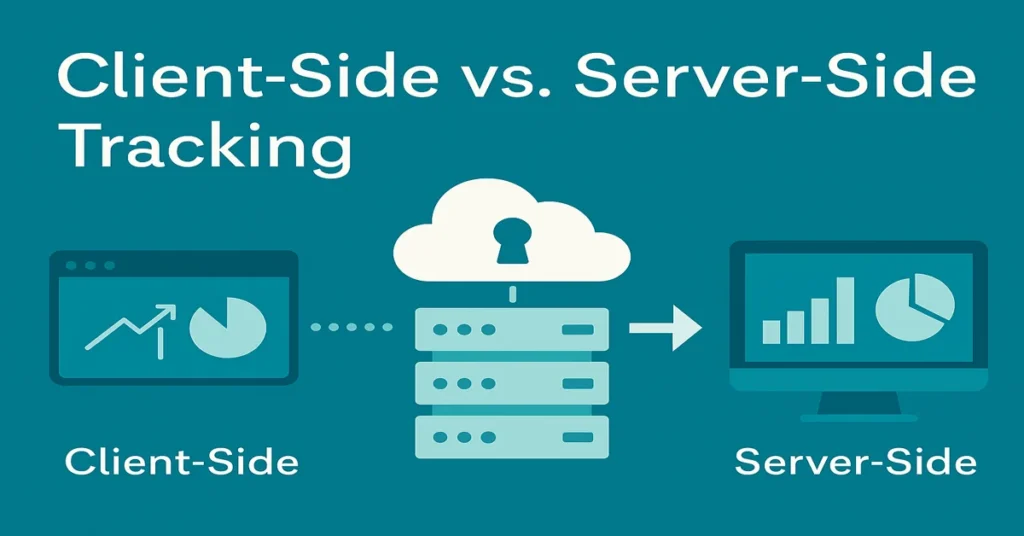
Server-side tracking sends event data from your web or app servers directly to GA4, rather than depending on the user’s browser. This single change delivers a cascade of benefits.
a. Data Accuracy and Integrity
Server-side tagging ensures your GA4 data is complete, validated, and unaltered before it reaches Google Analytics. It captures all relevant parameters consistently—across browsers, regions, and devices—reducing data loss.
b. Enhanced Privacy and Compliance
In the server environment, companies can control exactly which user identifiers, cookies, or parameters are sent. This makes it easier to comply with GDPR, CCPA, and other data protection laws while still enabling robust analytics.
c. Greater Control Over Data Flow
Server-side tracking acts as a data governance layer. It allows corporations to:
- Filter or transform event data before it’s sent to GA4.
- Remove sensitive information automatically.
- Route the same data to multiple destinations (GA4, CRM, BigQuery, ad platforms, etc.) efficiently.
d. Reduced Impact of Ad Blockers
Since server-side requests don’t rely on client scripts or Google’s default domains, they bypass most ad blockers—restoring 20–40% of data previously lost due to browser-based blocking.
e. Improved Page Speed and Performance
Client-side tags slow down page load times. By moving data collection to a secure server container (e.g., Google Tag Manager Server), you:
- Reduce browser script execution.
- Improve Core Web Vitals.
- Enhance both user experience and SEO performance.
Strategic Benefits for Corporate Marketing Executives
Unified Data Infrastructure
When GA4 events flow through a server-side container, they can be seamlessly connected with:
- BigQuery for raw data analysis.
- Google Ads and LinkedIn Ads for accurate conversion imports.
- CRM or CDP systems for cross-channel audience targeting.
This unified infrastructure enables an end-to-end view of marketing ROI and customer journeys—essential for enterprise-level decision-making.
Future-Proof Measurement
As browsers and regulators tighten data controls, client-side tracking will become increasingly unreliable. Server-side tracking ensures your measurement strategy is future-ready, built for a world where first-party data ownership is the only sustainable model.
Competitive Advantage
Companies that deploy server-side GA4 early gain a strategic edge:
- Cleaner data for smarter bidding and personalization.
- Faster integration with AI-driven marketing platforms.
- Reduced reliance on third-party cookies and vendor data black boxes.
Real-World Use Case Scenarios
Scenario 1: A Global B2B Manufacturer
A global manufacturing enterprise implements GA4 server-side tracking to consolidate user interactions across more than a dozen international websites. By routing all analytics through a central server container, the company achieves significantly improved data consistency—typically in the range of 25–35%, according to industry reports.
Marketing teams gain a unified cross-region attribution framework that minimizes cookie dependence and ensures consistent KPI measurement across markets.
(Supported by: Single Grain, 2024; Google Marketing Platform Case Study, 2023)
Scenario 2: A SaaS Enterprise
A SaaS company reroutes all GA4 events through its server-side container and enriches each event with CRM and first-party identifiers before exporting to BigQuery.
This configuration allows integration of behavioral, marketing, and lifecycle data into one warehouse, creating a 360° customer intelligence view that supports remarketing, predictive audiences, and churn-risk modeling.
Performance analysis based on similar implementations suggests that organizations adopting server-side event enrichment see notable increases in attribution accuracy and retention-model precision compared to client-side setups.
(Supported by: Piwik PRO, 2024; Google Cloud + BigQuery ML Documentation)
Scenario 3: An eCommerce Corporation
An enterprise eCommerce brand transitions to server-side GA4 tagging, reducing reliance on client-side scripts that were often blocked by browsers and ad-blockers.
Within months, analytics reports show recovery of 20–30% of previously untracked conversions, while optimized tag execution and fewer front-end scripts improve page load performance by 15–20%—both factors contributing to better conversion rates and organic search visibility.
(Supported by: Connective3, 2024; Google Developers Tag Manager Documentation)
Executive Takeaway
Client-side tracking is a relic of the open-cookie era—fast becoming obsolete under today’s privacy, performance, and accuracy demands.
Server-side tracking is the modern enterprise standard for GA4 data—delivering cleaner insights, compliance control, and marketing intelligence at scale.
For corporate marketing executives seeking accurate, privacy-resilient, and future-proof analytics, server-side infrastructure is not just a technical upgrade—it’s a strategic imperative.
It’s the difference between guessing at marketing impact and knowing it with confidence.