
AI Search Engine Optimization:
The New Fight for Visibility in 2026 & Beyond
- Home
- AI Search Optimization
Table of Contents
Why Corporate Marketing Must Move Beyond Traditional SEO
In the rapidly evolving world of digital marketing, one truth has become unavoidable: traditional search alone is no longer sufficient. The rise of generative-AI powered discovery — from answer-bots to AI-augmented search engines — is fundamentally changing how audiences find, consume and act on content. For enterprise brands, especially in B2B or high-stakes verticals (like microelectronics manufacturing, medical devices, aerospace/defense, or enterprise analytics), the risk is real: you may be present in search rankings … yet still be invisible to your most valuable decision-makers.
The Market Shift: Fast-Growing, Irreversible
Here are the facts:
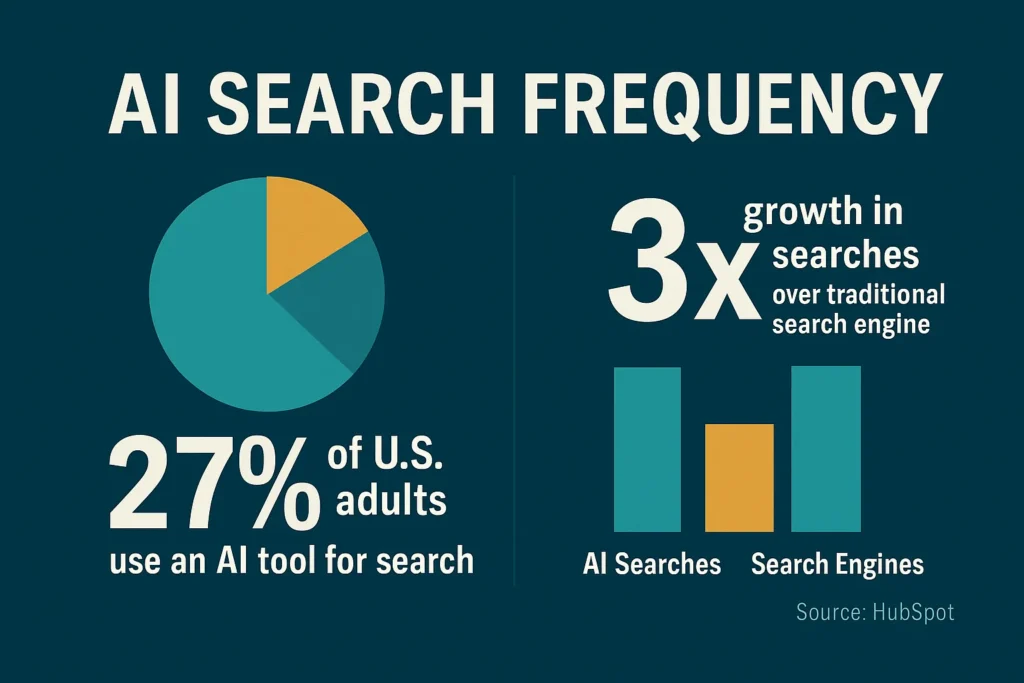
- According to research by BrightEdge analysing thousands of queries from January to August 2025, AI search referral traffic is experiencing double-digit month-over-month growth, even though it still accounts for less than 1% of referral visits today. (BrightEdge)
- In March 2025, a study by Pew Research Center found that users who encountered an AI-generated summary in Google search clicked traditional links only 8% of the time — compared to 15% when no summary appeared. (Pew Research Center)
- The global AI market is projected to grow rapidly: one estimate puts the global AI software market with a CAGR of ~25–35%. (SEO.com)
- According to an article by Adobe, from July 2024 to February 2025, web traffic from AI-driven referrals in the U.S. increased more than ten-fold. (Adobe for Business)
What does this mean? Search is still the bedrock of digital visibility — but AI-driven discovery is the fast-moving front line. If your brand relies solely on classic SEO positioning, you risk being excluded from the “answer layer” that modern decision-makers increasingly use.
Why This Matters to Corporate Marketing Executives
- Your buyer‐audience is already using AI to research. Enterprises report high adoption of generative AI across functions, including marketing, sales intelligence, and analytics.
- AI is growing faster than traditional search in key discovery moments. While organic search remains dominant, the fastest-growing channel for future referrals is AI.
- Clicks are shifting. When an AI answer appears upfront, it often reduces clicks to downstream sites. A nearly 35% drop in CTR has been observed when an AI-generated summary is present. (WordStream)
- Decision-makers value speed and succinct answers. Corporate purchasing research, vendor evaluation and industry benchmarking are increasingly done via AI assistants rather than 10 blue-links.
- Measurement and attribution need to evolve. In a world where the “answer” is surfaced before the click, brands must surface data via analytics (such as GA4 + BigQuery) to understand impression-level attribution, not just click-based conversion.
The Executive Risk: “Invisible Under the Answer”
Picture this scenario: Your brand’s blog ranks #1 for a strategic keyword. Traffic looks stable. But your visibility still drops because an AI answer appears above your link — the user gets the solution without clicking through. You rank well yet miss the engagement. Several publishers in 2025 report traffic declines of 20–40% or more for queries where AI answers are served.
In short: You can be found, but not seen. The rise of “zero-click” answers means you must optimize for being cited rather than just being ranked.
What AI-SEO Actually Means for Your Content Strategy
- Audit your top informational/decision-stage pages now. Identify pages that rank well but see falling engagement or conversions — they may be impacted by AI.
- Add answer-ready modules. Add short, bullet-style answer blocks, data tables, FAQs, citations, schema markup.
- Embed AI-visibility KPIs into your analytics. Create dashboards that monitor not just clicks, but visibility (impressions, AI-referral proxies, scroll depth, bounce).
- Update governance processes. Content must remain timely, accurate, and structured for AI-readability — treat every piece as both a human asset and a machine-readable asset.
- Budget for AI-SEO now. The window is open: ranking positions are still meaningful, but the visibility paradigm is shifting — brands that act now gain advantage; brands that wait face invisible decline.
The Strategic Mandate for Corporate SEO in the AI Era for Marketing Leadership
A corporate SEO leader must deploy a high-caliber skill set that integrates technology, analytics, and strategy. It includes:
- Technical SEO – Optimizing site architecture, indexing, Core Web Vitals, and crawl efficiency.
- Content Strategy & Optimization – Crafting search-intent aligned content that builds topical authority.
- GA4 Data Intelligence – Linking SEO outcomes with engagement and conversion metrics.
- Competitive Research – Using AI-driven tools to analyze competitors’ strengths, backlink profiles, and keyword gaps.
- Schema & Structured Data Implementation – Enhancing visibility in rich search results and SERP features.
- Link Building & Digital PR – Strengthening authority through credible mentions and quality backlinks.
- Performance Tracking & Reporting – Leveraging dashboards to visualize SEO’s revenue impact.
Future-Proof Your Brand Authority for AI Discovery
For corporate marketing executives, the message is clear: the discovery platform is evolving, and your visibility strategy must adapt to it. Classic SEO is no longer enough. It’s time for AI Search Engine Optimization — positioning your brand to be cited by AI, not just listed by search. With the right analytics foundation, vertical focus, and executive positioning, a corporation can be uniquely placed to lead that shift.
Is your content ready to be the answer?
References
- AI Search data & growth trends: BrightEdge, January-August 2025. (BrightEdge)
- Click reduction when AI summaries appear: Pew Research Center (March 2025) (Pew Research Center)
- Global AI market growth projections: SEO.com & DemandSage (SEO.com)
- AI-referral traffic growth (U.S., Jul 2024-Feb 2025): Adobe blog (Adobe for Business)
- Google blog: AI Mode / AI Overviews rollout in Search (May 2025) (blog.google)