
Segmenting Strategy in GA4:
The Core of Data-Driven Marketing Intelligence
- Home
- Segmenting Strategy
Table of Contents
Segmentation is one of the most fundamental principles of data analytics. In Google Analytics 4 (GA4), segmentation has evolved from static, retrospective filters into dynamic, real-time intelligence systems that reflect the full journey of the customer across devices, platforms, and marketing channels. This article explores the role of segmentation strategy in GA4 as an advanced analytical framework for behavioral insights, predictive modeling, and marketing optimization.
The Evolution of Segmentation in Digital Analytics
In the Universal Analytics era, segments were primarily based on pageviews, sessions, and goals. GA4 transforms this concept by centering around events and user properties. This paradigm shift enables marketers and data analysts to define audiences and segments based on behavioral signals rather than session constructs.
In GA4, segmentation operates across three primary dimensions:
- User segments — based on cumulative behavior (e.g., returning customers, high-value purchasers, or engaged users).
- Event segments — focused on specific interactions such as form submissions, video views, or conversions.
- Session segments — identifying traffic patterns, source effectiveness, or session-specific engagement depth.
By applying segmentation across these dimensions, marketers can interpret performance through the lens of audience behavior, not just aggregate metrics.
Segmentation as a Foundation for Marketing Intelligence
GA4’s segmentation strategy functions as the analytical core of marketing and attribution intelligence. When integrated with advertising ecosystems such as Google Ads, Search Console, and LinkedIn Ads, segmentation provides actionable insights into the path users take before conversion.
Key outcomes of a structured segmentation strategy include:
- Attribution Clarity: Segments reveal how marketing channels interact to drive conversions across the funnel.
- Audience Refinement: Behavioral segmentation informs remarketing and lookalike strategies.
- Predictive Targeting: GA4’s predictive metrics—such as purchase probability or churn probability—can be applied to segments for AI-driven optimization.
- Cross-Platform Cohesion: Segments unify data across web, app, and CRM touchpoints, producing holistic user views.
For corporations operating multiple digital properties, segmentation becomes a mechanism for aligning analytics, paid media, and CRM data under a single intelligence model.
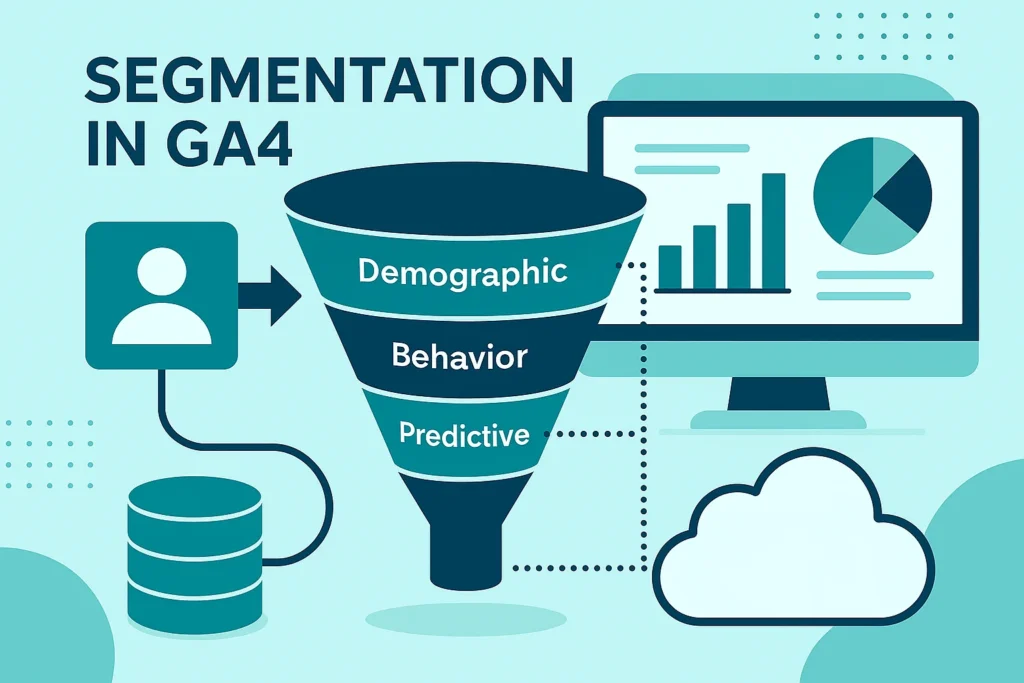
Types of Segmentation in GA4 Explorations
GA4’s Explorations workspace offers powerful segmentation frameworks that transform how analysts interpret behavior patterns:
- Demographic Segmentation
Segments based on geography, device category, or language reveal which user cohorts generate the most value across regions or devices. - Behavioral Segmentation
These segments are defined by events such as video engagement, downloads, or custom conversion triggers—allowing optimization of user journeys. - Acquisition Segmentation
Segments built around traffic sources (e.g., organic search, paid social, referral) show which channels contribute to upper- and lower-funnel engagement. - Predictive Segmentation
GA4’s machine learning models automatically create segments such as “users likely to purchase in the next 7 days” or “users likely to churn,” providing proactive marketing intelligence. - Custom Event Segmentation
Enterprises can build segments that capture micro-interactions—like scroll depth, click clusters, or engagement on key B2B assets—to understand how prospects move toward conversion.
Strategic Implementation for Enterprises
A robust segmentation strategy in GA4 must align with business objectives and customer journey mapping. For enterprise-level organizations, the following steps are essential:
- Define Key Behavioral Signals: Identify which user actions best represent engagement and conversion intent.
- Develop Segmentation Taxonomy: Establish consistent naming conventions for user, event, and predictive segments.
- Integrate with BigQuery: Export segment data to BigQuery for multi-dimensional analysis, combining CRM and offline datasets.
- Activate Audiences: Connect GA4 segments to Google Ads or Display & Video 360 for remarketing and audience expansion.
- Monitor and Iterate: Use Explorations to continuously refine segments based on emerging behavioral patterns.
This systematic approach transforms segmentation into a living, adaptive framework that fuels decision-making across analytics, media, and executive reporting.
Use Case Scenarios
A. B2B Lead Generation
A technology manufacturer segments website users based on engagement with “Request a Quote” forms, whitepaper downloads, and product page views. These segments are synced to Google Ads for remarketing campaigns targeting users with the highest conversion probability.
B. E-Commerce Optimization
A retail brand segments users by high-value cart additions and purchase frequency, applying predictive metrics to identify likely repeat buyers. These insights inform personalized email automation and dynamic ad creatives.
C. Cross-Channel Performance Analytics
An enterprise integrates GA4 with BigQuery to analyze audience segments by acquisition source. The result: a clearer understanding of how LinkedIn Ads contribute to top-funnel awareness while Google Search drives final conversions.
Executive Takeaways
For corporate decision-makers, segmentation in GA4 represents a strategic intelligence capability, not just an analytical function.
Key implications for enterprise growth include:
- Actionable Insight at Every Layer
GA4 segmentation delivers granular visibility into who your audiences are, what behaviors drive conversions, and which marketing levers generate ROI. - Smarter Budget Allocation
Executives can reallocate spend toward the audience segments and channels demonstrating the strongest predictive conversion signals. - Data-to-Decision Continuity
Integrated with BigQuery and CRM platforms, segmentation bridges marketing analytics and sales intelligence—creating a unified view of the customer lifecycle. - Future-Proof Measurement
As privacy regulations reshape data collection, GA4’s event-based segmentation ensures long-term measurement resilience and compliance without sacrificing insight quality. - Competitive Differentiation Through Intelligence
Organizations that operationalize GA4 segmentation across analytics, media, and executive reporting will outperform peers that rely on static reporting or outdated attribution models.
In short, segmentation in GA4 transforms data into a strategic asset—one that turns visibility into foresight, and foresight into growth.
Conclusion
GA4 segmentation is not merely a technical function—it is a strategic intelligence framework. By combining behavioral analytics, predictive modeling, and cross-channel integration, segmentation in GA4 empowers corporations to turn fragmented data into a cohesive narrative of customer intent.
In the era of privacy-first marketing and AI-driven optimization, mastering segmentation strategy in GA4 is the foundation of sustainable digital intelligence. Enterprises that operationalize segmentation across analytics, media, and CRM platforms will gain not only deeper insights—but measurable competitive advantage.
References
- Google Analytics Help Center. Create and manage segments in GA4.
- Think with Google. The future of measurement in a privacy-first world.
- BigQuery + GA4 Documentation. Advanced analytics and predictive audiences.
- Bounteous. Strategic segmentation for enterprise analytics.
- Deloitte Digital. AI and behavioral segmentation for performance marketing.